

2026 Idea Dump

AF just went on its annual summer break in June, and I spent the most glorious two weeks up north for some much needed, off-the-grid time. One of those weekends I completed a mountain skills course in the Dark Peaks, scrambling up cloughs and gulleys, scraping my palm against the gritstones, stinging nettles and heather fields. We learnt this navigation technique called “aiming off”, where in order to hit your target, you should counterintuitively walk towards something slightly askew from it. Everything is distorted in the wilderness, so much so that the most obvious path might eventually take you off course, and the safest route could appear at first to be a detour.
Consider these idea dumps, then, a practice in aiming off, where we will hopefully end up where we intended.
My Mayor’s Muslim, Knicks in Four
For those outside of New York or the NBA world, the Knicks winning the championship for the first time in 53 years doesn’t really mean much. For a media and entertainment observer, however, I’ve been fascinated by how sporting events and sports fandom cultures become once again exploited by celebrities and politicians alike to cultivate their own persona and following.
Ever since the start of the Knicks’ uptick in performance earlier in the season, Kylie Jenner has been joining Timothee Chalamet and sitting courtside, while wearing carefully curated “down to earth” outfits to blend in with the commoners. I make such a deduction with certainty, because I know celebrities worldwide are unanimously and desperately attempting to appear relatable. You see this in how Kylie did a makeup tutorial video for that match appearance, framing it as a simple “date night”, all the while being on a private jet and claiming that she only flew in for a 24 hour stay. You can also see this in how Lewis Hamilton hard-launched his relationship, posting Kim K’s accidental near-fall on a rental bike to his Instagram stories like every other middleschooler couple on Snapchat. Over on the home front, the actress Shen Yue made an offhand comment recently about how she goes home once every year, and she sorely misses her family. Some of the responses were brutally honest: us too, and we cannot sympathise with someone who earns exponentially more than us wage slaves.
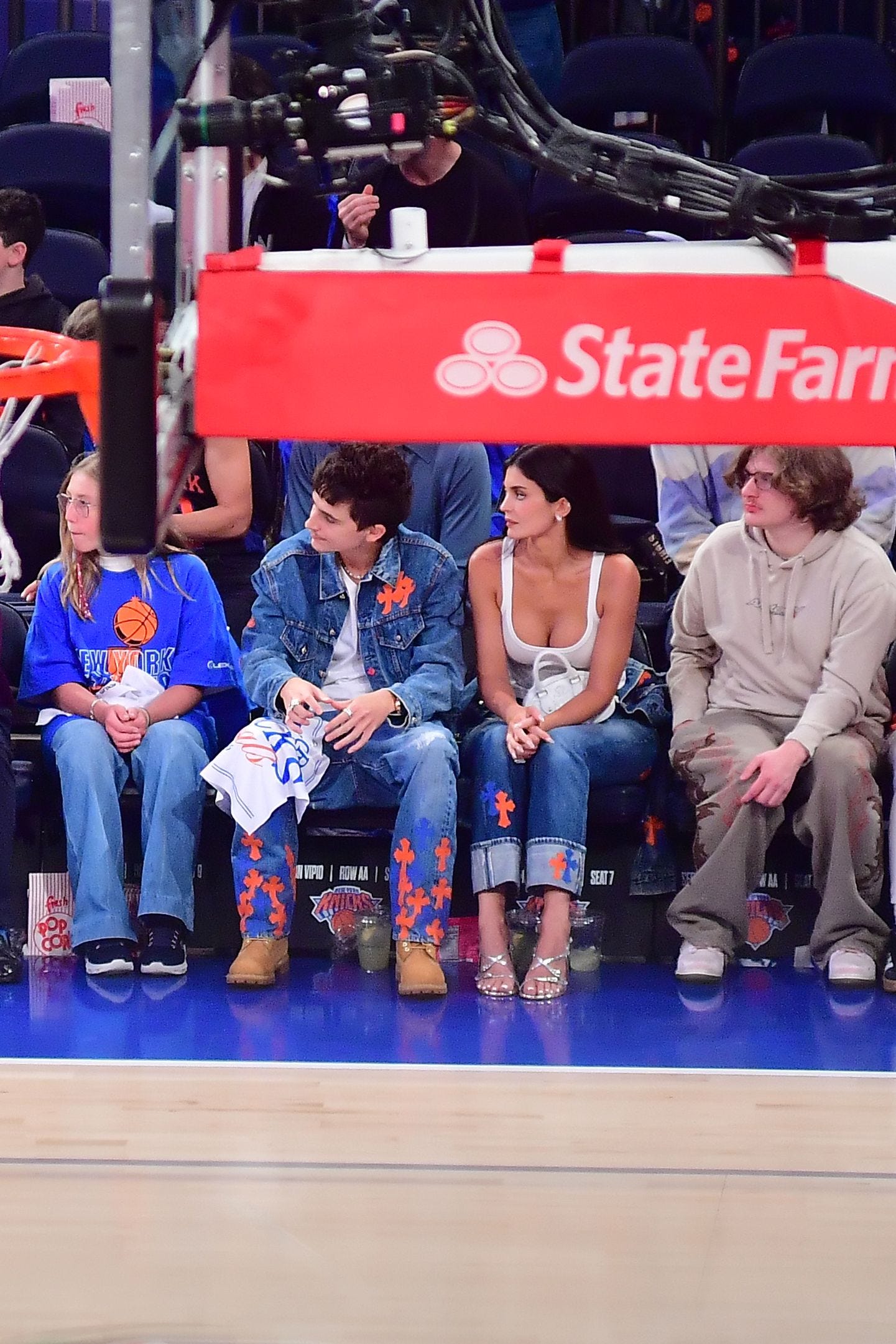
By the time the finals rolled around, celebrities sitting front row supporting the Knicks included Taylor Swift, the HAIM sisters and Ben Stiller. Hailey Bieber and Tate McRae were also there, as well as Jimmy Fallon and Sydney Sweeney, all donning Knicks merch and full glam like they are at a PR event, which, I argue, is precisely the case. Sport games have become (and to a lesser extent always have been) an opportunity, an occasion for public figures to mine for approachability in this painstakingly try-hard way. Sure, a lot of it is driven by external factors, as Madison Square Gardens allegedly gave out free tickets to specific celebrities in exchange for more hype. But that doesn’t negate or annul the increasingly conspicuous desire of these big names to stoop down in a particularly anti-wealth time.
On the other hand, politicians are using the occasion to an identical end. Trump appeared in a VIP box at Game 3 where he was “thunderously booed” as the first sitting president to attend an NBA game. He allegedly fell asleep. That was the only game the Knicks lost.
Meanwhile, Zohran Mamdani manoeuvred most artfully around the Knicks wins as if he needed any more diehard followers. First, he cued his entrance at an event with Livin La Vida Loca by Ricky Martin, which he introduced as the song that was charting No.1 the last time the Knicks were in the finals. He signed an Executive Order repealing bedtime for children so they could stay up during these historic times. He only went to the courts once, and later he said that’s all he could afford. He watched all the other games with his people in gay bars and cosy pubs, wearing a jersey and his dress shirt underneath. He encouraged watch parties, and when those got shut down by James Dolan the team owner, he made sure to blast the game on digital screens all over the city for people to spontaneously gather. He live-tweeted, chanted with the crowds, and his team crafted so many videos celebrating the Knicks as a representation of the spirit of New York, in a way that everyone could resonate with.
One of the most skilful plays he pulled was pre-installing a fake bus in town in anticipation of the sports fan vandalism that was due to happen. That, and also getting NYC Sanitation to clean up the mess overnight after the win, while announcing an official parade in Manhattan like a lenient parent who said “ten more minutes of iPad time”. His victory parade speech was a linguistic masterpiece, celebrating how the Knicks didn’t win for New York but they won like New York, with their backs against the wall but grinding through the impossible odds nonetheless. His policy directions were clearly communicated through emotionally arousing rhetorics. Again I argue that he is someone who understands profoundly the spirit and potential of fandom (probably by being an Arsenal fan himself), which is that it gives people life and a common goal. Look towards his World Cup activities rollout for more of that mobilisation of fandom. I look at his Instagram page and think he should be included in the new edition of Sun Tsu’s Art of War if we ever do a reprint.
When other mayors lack that foresight, you’ll get a rioting Paris and a trashed-up London. I live very close to the Arsenal stadium and during the championship playoffs my streets were flooded with the drunkest people I’ve ever seen, pissing down train tracks and setting fire in the stations. I do envy the extraordinary leeway and legitimacy that are given to a male-dominated fandom where every outrageous behaviour will be excused, and the same cannot be granted to “hysterical” concert girls. You would never see female fans commit any of this without an onslaught of criticism and internet lashings. When the boys do it they’re just “having a laugh” and being joyous.
¡Nueva Yol!
While we’re on the topic of concerts, June and July are my typical gig-going months where I almost live by the stadiums and on stuffy trains in my sweat-soaked outfits. I went to Bad Bunny’s sold out DeBÍ TiRAR MáS FOToS tour at the Hotspurs stadium, where I had the privilege of witnessing firsthand a poignant enactment of joy as a form of political resistance.
It was by far the most enthusiastic and diverse crowd I’ve ever seen, filled with fans of all ages, skin colours and backgrounds, decked out in outfits of every kind and speaking a wide array of languages. There were a lot of my own there, who I’d imagine also saw themselves as “plastic chair people” that the DtMF album staunchly celebrates, growing up in a hot and humid, “underdeveloped” third world country being told to chase a life elsewhere. It also had, surprisingly, the most balanced gender ratio I’ve seen in a long time, perhaps ever, and the men were not just there for their girlfriends.
Benito’s appeal is not dissimilar to Zohran’s—who just released a video educating people on the history of Puerto Rico—where it’s never about glam and sitting courtside. It’s always been about being as human as you can, even if the humanity is being broadcasted and marketed and worn like a costume but not in a disingenuous way. If you do it well, you’ll win over a city and come on stage to 60,000 people hooting for you for two minutes straight.
Throughout the show, I can sense that he was deliberately removing himself from the spotlight to, instead, put his country, his continent, and his culture front and centre. There are videos and pictures of Puerto Rico playing on the screens cueing his songs as if he’s from the Tourism bureau doing a promotional stunt. He gave each of his band members a solo segment, where he literally stepped away from the cameras and hid behind the entourage to take a tequila shot. When he went down to change outfits, the camera panned over the crowd and highlighted the flags people held up, all of which were of countries in the Americas. He explicitly mentioned the earthquake in Venezuela and the upheaval the country has faced. The only English words he spoke that day were “Good afternoon London, can I speak in Spanish?”
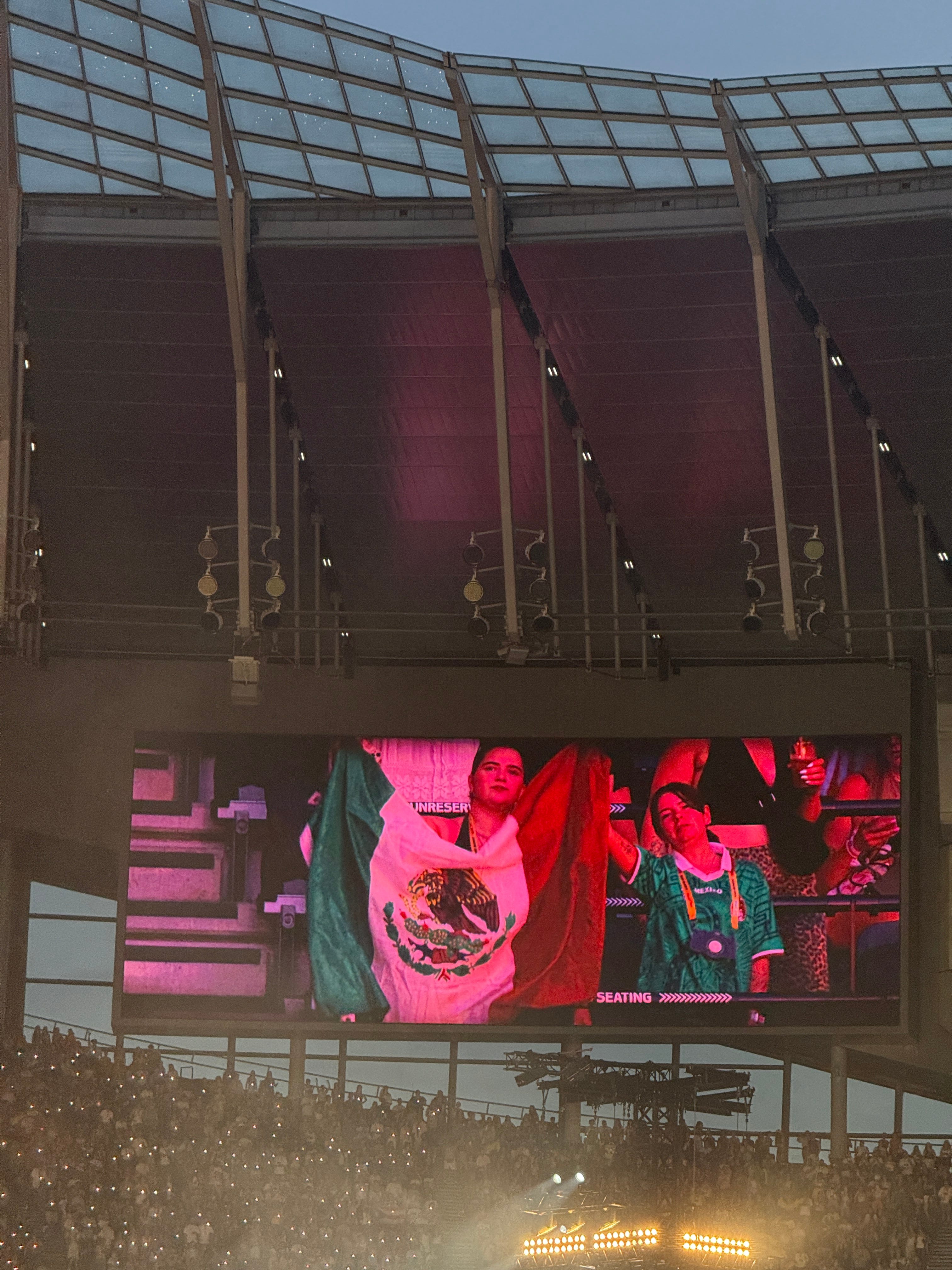
This insistence to disappear as “Bad Bunny” the singular performer into the backdrop of Latin music is a much more powerful stance than potentially becoming the (attractive) face of it. It felt like he was passing the baton onto another generation of artists now that he has set a precedent, where a foreign singer can be their defiant selves in the Euroamerican industry without catering to any listener’s palette. But I don’t think he will retire any time soon, judging by how much he genuinely loved his time on stage.
Three days before his concert I got some of the worst news I’ve ever received in life regarding my immigration status, which I won’t bore you with. I was struggling to do the bare minimum beyond waking up every day, let alone to stick to my original commitments and find respite in them. I was so close to bailing on Benito, because it was impossible to feel anything other than dread and despair in those moments. Yet he told us we can enjoy the simplest things like singing and dancing no matter what situations we’re in, and I believed him right there and then. I sang and danced and watched the fireworks, and laughed and cried and hoped. It is precisely in those instances where joy is as distant and improbable as an idol on a big stage that you must rejoice against all odds, time and time again.
The Kind of Greed They Talked About In the Bible
I’ve yet to update my concert review page with my Benito encounter, but I did write a note on TWICE. What I forgot to include was an interesting differentiation we noticed regarding merch. Groups with a predominantly male fanbase will design and release merch that are, for the lack of a better word, sloppy. The sizing ran big and unflattering, and the graphics were either too plain or straight up hideous. It’s almost saying that because men don’t care enough about fashion, we can skimp out on the aesthetics and quality without triggering complaints. It’s something I’ve noticed before when I went to a Formula 1 fan zone, but I haven’t put two and two together until now.
And if we’re talking about merch, we need to acknowledge that the prices are simply getting out of hand. BTS is on their mega sold-out reunion tour right now, and yes, as I and other fandom observers have predicted, they’ve rolled out city-wide takeovers in the form of restaurant collabs, light shows and pop-up stores and merch, just endless merch. A hair pin for £40. A hoodie for £100+. It feels less like fan service but more like robbery and dispossession at this point, where you are coerced into becoming a walking billboard for their event. You get an abhorrently overpriced knick-knack and they get a free ad at a huge profit.
But alas, I paid a hefty but acceptable price (what even is our definition of acceptability anymore and how skewed has it become throughout the years?) for a resale ticket to go see the Kings’ return. I screamed lyrics I didn’t know I remembered. I felt the fire from the stage and the way the ground shook. The music kept playing and I was 17 again, freshly foreign in a country that resisted my being. I blinked into the next second, this burning present, where the same resistance has grown tenfold but those beautiful faces and I have grown together into something that could withstand it.
I had a great time, although I did spend a large portion of my trip home ranting to my friend about the true Devil that Taylor Swift has unleashed into the music industry: Surprise Songs. I would go as far as to say that it is the Pandora’s Box of modern fandom, an unimaginably cruel and money-hungry scheme disguised as innocuous fun. This is the kind of greed they talked about in the Bible, baiting fans to attend as many shows as possible and bet on their chances of hearing their favourite songs live. It is unnecessary, extortionary and catching on way too quickly, spreading like wildfire from K-Pop to Harry Styles to C-Pop back home. You could argue that this has always been a way for artists to spice up a repetitive setlist, but they never ramped up the stakes this high.
Jay Chou used to get a random fan in the crowd to nominate a song which he would then sing acoustic, doing riffs and note changes on the spot and the whole stadium would laugh it off. It had an element of whimsy, of organic serendipity and of “默契”, which lacks an appropriate English translation other than “telepathic connection”. It is now a built-in segment, a regimented and regulated feature without this air of spontaneity, and fans treat it like psychological warfare. The amount of speculation, lore-dissecting, and over-the-top attempt at attendance took on this horrifying look of compulsion. I found myself feeling increasingly spiteful and bitter if I didn’t get the songs I wanted, like I was possessed.
Over-Capture
A similar compulsion is related to concert footage capture, which lies behind this need to “get barricade”, bring a quippy sign and get the idols’ attention. It is incredibly ironic that the front rows of a concert nowadays are less hyped than the fans at the back, because those people were never there to dance or sing. Their purpose is to stay as still as possible. They are there to film and post clips online for clout, as well as to breach the containment of a parasocial relationship into a quasi-tangible soc
ial connection with the celebrities, either to be noticed or remembered. If you are ever lucky enough to secure a ticket with a good view, you’ll experience an eerie silence and a sea of digital devices, documenting the artist’s every move while ignoring every bit of their craft. In one of BTS’ new songs, RM wrote the line “I need the whole stadium to jump / put down your phones let’s all get some fun / I’ve got my eyes on the rows at the front”. Paradoxically, this is now one of the most filmed-clips on social media.
Phoebe Bridgers recently played a no-phone gig in New York, to the internet’s mixed reactions. I am torn, because I am indeed someone who looks back at concert footage to relive them, but I will never film the whole show and not enjoy it. Most average listeners are in the hinterland like myself, who will be affected by a phone sea or a phone ban either way. I also see the argument that some fans with medical conditions might need their devices with them for health and safety reasons, while understanding the intention behind the artist’s decision. One thing is for sure though: this will never catch on in K-Pop. Fans would riot.
I want to blame the emergence of video fan-signs for this newfound obsession with “footage capture” and “celebrity interactions”. The pandemic has conceived a monster that is intense but bitesize intimacy between the celebrity and the fan, entirely recordable and spreadable, highly addictive and ego-inflating. The fan who orchestrates the interaction gets their satisfaction from bending the idol to their will, as well as from the wider fan community when they later publicise this interaction to more cooing, gratitude or even and especially jealousy. The fan who watches the interaction gets seduced into wanting the same treatment, like getting inducted into a pyramid scheme. When this compulsion translates into the offline world, it manifests in ticket and barricade hung-ups.
Overall, entertainment is being over-captured. I’ve written about the fan tendency to conduct microscopic, hyper-analysis of celebrity behaviours, and turning everything into a “study”.

Every second of content would be played back, slowed down, unpacked and interpreted. Neiyu’s latest targets have been the actor Wang Hedi and the actress Bai Lu, where a couple of minutes of their reality TV appearances revealed them to be rude and mean. Their past interviews then got dug up and reviewed, and evidence accumulated to an eventual storm of critique. Interestingly, I’ve noticed the same with Western pop-stars, where lip-readers and “body language experts” would dissect a celebrity interaction down to its bare bones. Over in South Korea, Jang Wonyoung and Sungchan from RIIZE are now under fire for being rude to airport staff, while the actor Choi Woosik was accused of racism towards a black fan during fashion week.
It seems to me that people are even less tolerant of celebrities in an age where inequity cuts sharp and deep. No wonder that Zohran is winning over the world.