

08. Livestocks
2025 Idea Dump

Hi there. Welcome to Active Faults.
Every summer I try to come home and commit to a writing break, where I ingest and reflect rather than produce. Absorb and receive instead of excrete and deplete, soaking up stories from friends I haven’t seen in a while, sounds of cicadas and smells of wet foliage, the sticky air, the sudden showers that flow through the city like a river, the rain-mud caking the asphalt that makes my tyres skid. It’s reading weather, thinking weather, breezing past unfamiliar songs in the car while stuck in the traffic kind of weather, lazing around in the deserted cinemas kind of weather.
Here are some hovering thoughts in the draft box and those humid moments.
Bookstores are dying.

These booksellers I reviewed three years ago are either struggling to keep paying their ground rents or rebranding entirely. The iconic PAGEONE Sanlitun has officially closed this month, on the ruins of which ARKET now sprawls and sells its upscale MUJI-esque shirts to no one. I happened to acquaint the head of PAGEONE Beijing a couple years back, and he posted the closing announcement on his WeChat Moments beckoning everyone to visit their new location.
The last book I bought from this store was “阿包” (Ad Bel), a memoir of a Guizhou woman who was abducted and sold into marriage. It was one of the saddest things I’ve ever read. It was one of the few remaining titles in the store that were sharp, poignant and critical, that weren’t just mellow foreign “classics” or completely fictionalised, hence safe-to-publish Japanese detective thrillers.
One Way Street closed its flagship cultural salon in Joy City a while ago. They relocated to Lang Yuan, which is a suburban, outdoor shopping park recently renovated from a rundown power station, and only occasionally remembered by the city dwellers. Probably to protect itself.
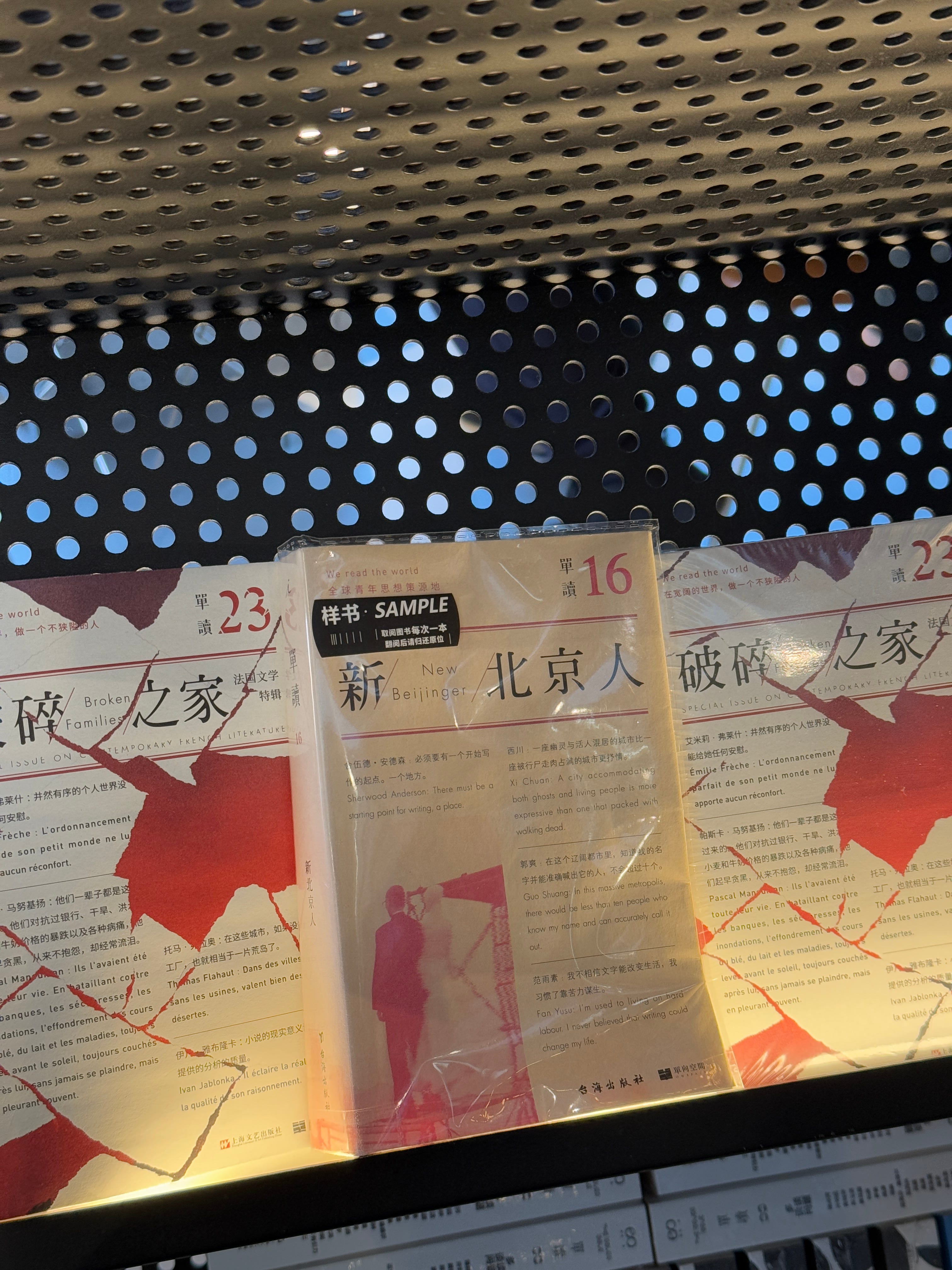
All Sages relocated to Wudaokou Shopping Centre after the pandemic. The flattened, open-concept floor plan has none of the cosiness, mystique, and heroic romanticism of its original location. It smelt sour and stagnant, like the milk tea place next door. The grey halogen light bulbs gave me a headache, and they glared at me like the eyes of a suffocating fish.
Meanwhile, shopping complexes are water-logged with restaurants, but ghostly empty everywhere else.
I’m talking an absolutely swarming amount of eateries, regional cuisines from every single province and foreign country, two, three, four floors worth of blinding billboards and technicoloured lights and microphoned hostesses shouting for customers. Plastic stool queues pour out from the entrance onto the walkways. Saccharine sweet robot voices call out queue numbers. Every corner of the entire structure smells like a greasy kitchen, like something from The Bear. I keep finding my clothes in various states of reeking after a brisk walk through these quarters, because the ventilation systems of these buildings are not equipped for this density of stir-fry smoke. It’s carcinogenic. I wonder if a few decades from now we’ll see a spike in tumorous growths in our bodies, simply from the sheer amount of restaurants we’re surrounding ourselves with.
I took this video in Shenzhen’s Link City, a medium-sized mall of…2% shops and 98% restaurants. It’s connected to several other malls in the area via underground tunnels that offer at least another 200-or-so options of food, drinks and desserts. Please turn up the sound and you’ll know why I was overwhelmed into documenting it:
The video encapsulates everything that is changing about China’s consumption patterns.
Spend what you have on eating well. At least it turns into an instantaneous, visceral satisfaction, felt deep in the flesh, a kind of fibrous, meaty certainty that (promises of) promotions and cars and properties can no longer provide.
Spend what you have on kitschy, senseless things. As you can see from the video, Link City’s atrium has a pop-up store of TXT’s animated characters, “PPULBATU”, filled with overpriced plushies, keychain blind boxes, cardboard floorboards charred by shoe soles. It has two Pop Mart vending machines, and I watched a row of freshly restocked Labubus sell out in real time. It has a few clusters of those coin-pushing arcade machines, chiming and tinkling away as people kill time with a handful of loose yuans. It has a dozen of those stores of cute junk, walls and walls of fluffy, palm-sized trinkets. They drown out any and all thoughts of a future where we toil, age and disappear.
If we’re never getting out of the grind as “livestocks” (牛马, a new slang for wage-workers, literally translates to cows and horses), then there’s no point in delaying satisfaction. No point in saving up towards anything, investing in anything, waiting for anything. Godot jumped off a building because of a salary cut. If we will never have the freedom to choose how to live, then we must imbue our lives with choices we can make: fried chicken or hot pot or korean barbeque?
The video is loud, full of the commotion of a metropolitan hub on a Sunday night. If you listen closely, you’d hear death and lifelessness in the noises, loud as a bang when you close a book.
Two weeks ago, TXT announced their contract renewal and entered what’s regarded as the most important developmental stage of idol groups. This is the make-or-break, the most turbulent contractual period where everything happens: burnouts, enlistments, hiatuses, individual activities and the subsequent fandom fractures. Though I do have faith that they will make it out of the deep end, partly because I’m not holding my breath for their successor.
BigHit has debuted their third boy group, CORTIS, on the 18th of August, just in time before the backbones of K-Pop fandom go back to school. For months, there’s been a fair amount of fuss and feathers over the lineup, the next generation talents who might go on to be the torchbearers of the BTS legacy. I’ve been made aware of them through my Bilibili algorithm. Their music videos, choreographies and stage presences scream male Hip-Hop New Jeans. The whole aesthetic is very much going down the same VHS tape and California Dreamin’ route, with an added bit of edge and tasteful “unhingeness”. The attractive spring-breaker friend group you bump into at Coachella.
From what I’ve seen, they dance pretty hard in front of the cameras. The song is not bad for an inaugural album. There is visual chemistry, height and proportion consistency, financial backing of an industry czar. But they are also on their way to flatlining. I cannot really cite any sources other than my intuition as a long-time fan. You’d get those with seniority. You start to sense danger after spending years in the jungle.
One of the members, Keonho, looks like the stunning lovechild of Cha Eunwoo and V, and is so popular that there’s a 断层 between his following and everyone else’s. His face cams on Xiaohongshu are watched thrice more and his name is often the suggested search term on video platforms, meaning his popularity has trained the algorithm to anticipate the user’s next move (look him up and become a fan). Sure, an exceptionally fan-attracting member might be beneficial to the group in the early months. But if the other members don’t catch up and achieve relatively equalised fan counts as quickly as possible, the Jenga tower will crumble in the long run. Solo stans will appear, outnumber the rest and spread a splintering, group-hating, company-hating agenda. I’m already seeing fans of Keonho calling other members ugly in the comments.
Music-wise, their songs have not moved past the “catchy noise” conundrum that plagues most currently active groups. Despite recent arguments that hail physical appearances over the quality of music as the main success factor of idols, I’m still a firm believer that music has the final say. It retains. It’s what keeps you coming back. It has to be genuinely meaningful, melodic and energising, not just stitchable on TikTok. “Golden” from K-Pop Demon Hunters is a case in point.
If the management team of CORTIS is reading this: make better music. Invest in producers and engineers. Hold back on touring and send them into the studios for full-length albums containing songs longer than 3 minutes. Get them to write their own lyrics. Get them on reality shows or make in-house content that demonstrates their group dynamics as well as their individual colours, the intricacies of their personalities. Create backstories that go beyond “I’m hot and I’m a surfer boy from SoCal and I part-time at Hollister”. The kind that sets them apart, gives them arcs that makes them feel real, gives people someone to root for and someone they see themselves in. Invest in a robust bond, within the group and with the fans. Hold back on fan signs, merch lines, and pop-ups, anything that smells like hasty financial exploitation. Allow fans to have the breathing space to relate, appreciate and dedicate.
And most direly: stay away from AI.
Perhaps this ushering in of idols born in the 2010s is what catalysed a new term for a specific ambience in fanquan: “盛大的落幕感”, feelings of a grand epilogue. I watched compilation videos of idol songs that evoke this kind of symphonic, reverberating melancholia that is also tinged with vitality. Something that refuses to be put down without a scream, something raging against the dying of the light, something that must curse as its last words. They nominate songs like ITZY’s Imaginary Friend and SEVENTEEN’s Fallin’ Flower (a personal favourite), analysing that “落幕感” is popular because everyone experiences grief and finds grieving relatable. It’s true.
But I wonder what else is behind this longing for an emphatic exit. Another video has lived in my Favourites folder (also known as AF source material folder) for a while, a simply incredible piece of fandom artefact. It’s a recording of a Chinese fan’s conversation with the teammate of her ex-idol (both South Koreans), after she un-fanned. She bumped into him by chance and he recognised her. They talked, for the first time, on equal footing, human to human.
“Are you well? I haven’t seen you in a long time.” The teammate asked, using the informal grammar in Korean. His voice was altered to protect his identity.
“Yeah, I just un-fanned.” She chuckled.
“Huh, you’re still alive?” The teammate quipped.
“Of course! Is he[ex-idol] alive?”
“Who is he?”
They both laughed.
You should watch the whole video to feel how easy and unpretentious the interaction felt. Only a fan would know how impossible this is when you’re still a fan. It is only on the other side of love that love could be as tender as indifference.
They go on to talk about how 2-minute fan signs are bullshit, and that there’s no opportunity for a heart-to-heart conversation even when you’ve known each other as a fan and an idol for 5 years. There’s no space for genuine connections, authenticity, a moment of interest in its purest, etymological sense: inter esse, to be between one another, standing on common ground.
She wrote in a postscript that it is only then that she saw who he really was, someone smaller than life, just like her.
That’s why fandom is currently obsessed with finales: with closure comes true understanding. With closure comes something real.
Retail collapsing whilst consumerism skyrockets feels like it must mean something. (What that is remains unclear.)